
Lifting
Sofwave for fine lines and pores: who it suits, who it doesn't
Sofwave is not a lighter Ultherapy. It works on a shallower layer, the mid-dermis, and for fine lines around the eyes and mouth it is often the first device I look at.

Written and reviewed by Dr. Hanaram Jang, Medical Director
Published / 5 min read
On this page
"Sofwave? Is that better than Ultherapy?" Most people who have heard of Sofwave ask me this. Because it is less famous than Ultherapy or Thermage, some assume it is a lower-grade device.
My answer: Sofwave is a different tool that works on a layer Ultherapy does not aim at. And for some faces, it is the first choice.
Same energy type, different job
Ultherapy and Sofwave both use ultrasound. They still do different work, because the physics is different.
Ultherapy is micro-focused ultrasound (HIFU). Like a magnifying glass concentrating sunlight, it gathers energy into points, passes the surface and makes small coagulation points in the deep SMAS fascia. It pulls loosened structure.
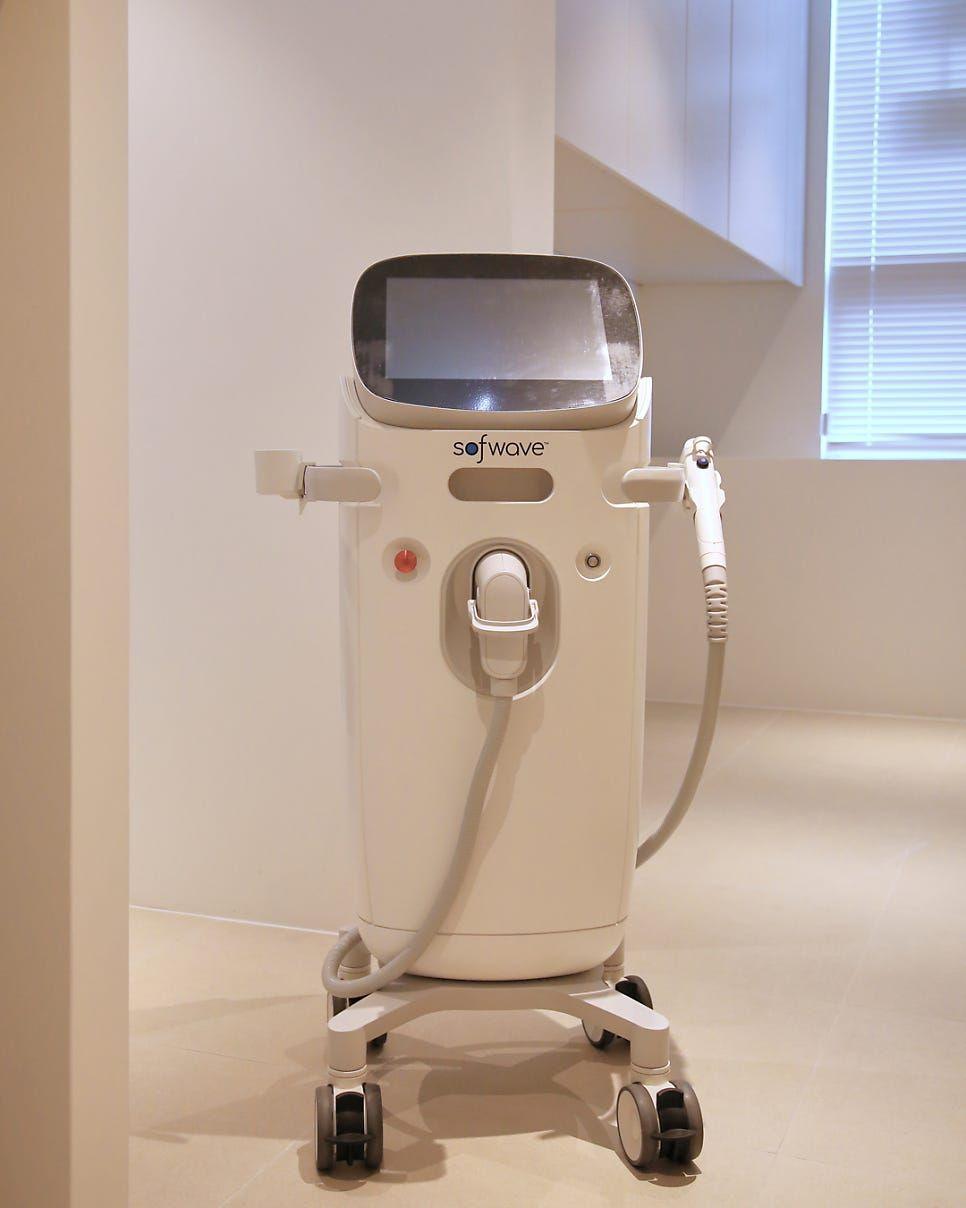
Sofwave fires ultrasound in parallel beams, a technology the maker calls SUPERB (Synchronous Ultrasound Parallel Beam). It creates an even band of heat in the mid-dermis at about 1.5 mm. It goes wide and even instead of deep. An integrated cooling system protects the skin surface during treatment.
Concentrated and deep versus parallel and shallow. So "Does Sofwave lift as much as Ultherapy?" is the wrong question. Pulling is Ultherapy's job. Sofwave came to do something else.
Why the 1.5 mm layer matters
The mid-dermis holds much of the collagen and elastin that keep skin firm, plus hyaluronic acid that holds moisture. When collagen declines, skin loosens, fine lines appear and texture gets rougher.
Sofwave delivers controlled heat into this layer to encourage new collagen and elastin. Think of it as making the skin itself sturdier again, not hauling it upward. What to expect:
- better firmness and fine lines over time
- smoother texture and less visible pores
- a natural-looking change rather than a dramatic lift
In the United States, Sofwave is FDA-cleared for reducing facial wrinkles.
Three cases where I start with Sofwave
1. Fine lines and texture around the eyes, mouth and forehead. For shallow concerns in thin skin, a shallow device is more accurate than a deep one. Around the eyes, where care is needed, Sofwave is on home ground.
2. People in their 30s or early 40s who want a light start. At this age the SMAS is usually still firm. Recommending Ultherapy to a face that has no structural sag gets the order wrong. If the goal is to maintain the skin layer and prevent change, start with the lower-burden option.
3. Combining with Ultherapy or Thermage by layer. Sofwave handles the shallow dermis, Thermage and XERF the full dermis, and Ultherapy the SMAS. Because the layers don't overlap, the roles don't overlap. That makes a combination a division of work, not paying twice. Combinations are only for faces where several layers have changed. If one layer has changed, one device is enough.
Who usually does well with Sofwave
In consultations, Sofwave tends to fit people who describe one of these:
- "My skin doesn't bounce back the way it used to."
- "Fine lines are starting to appear one by one."
- "My face isn't dropping, but my skin looks thin and tired."
- "I can't afford visible recovery time."
For these concerns, encouraging collagen renewal in the dermis is a reasonable approach. The short session time and built-in cooling also make Sofwave easier for people who worry about discomfort, though sensation still varies by person and area.
If sagging is already advanced, Sofwave alone is unlikely to give the change you want. In that case I plan it with another device, or suggest a different device first.
When Sofwave is not the answer
If a dropped jawline, deep smile lines and sagging are your main concern, that is an SMAS problem. Smoothing the shallow layer will not pull the deep structure. In that case I recommend Ultherapy, and I say so plainly.
If the main concern is laxity across the whole dermis, Thermage FLX may fit better. If volume has dropped, a booster or filler conversation may come first.
How we plan Sofwave at ANDO
The device matters less than the plan. Before treatment, I check:
| Question | Why it matters |
|---|---|
| Which area comes first? | Eyes, mouth, forehead and cheeks differ in thickness |
| Is the face balanced left to right? | Energy can be distributed differently per side |
| Is volume loss or elasticity the main issue? | Volume loss may need a different treatment first |
| Is a combination needed? | Only when more than one layer has changed |
Sometimes Sofwave is done on its own. Sometimes it is planned with another lifting device or a skin booster for a more balanced result. Our menu lists Sofwave at 100, 200, 300 and 400 pulses. For example, 200 pulses is ₩1,990,000 (KRW, November 2026, excluding 10% VAT). See the full lifting price list.
If it were my face
I don't believe devices have a ranking. They have places. A famous device is not automatically the right one for your face, and a less famous one is not lower grade.
If my main concern were fine lines around my eyes, I would choose Sofwave over Ultherapy without hesitation. Since my own first concern is my jawline, Ultherapy comes first for me. The layer of the problem sets the order, not the reputation of the machine.
Planning Sofwave around a trip to Seoul
Sofwave suits short visits. Under our clinic's treatment standards, a session takes 30–40 minutes and recovery is same day. Mild redness or swelling can appear and differs by person. The usual interval is 3–6 months.
Like other collagen-based treatments, the change develops over the following weeks and months, so you will see more of it at home than in Seoul. Book ahead, as we are closed on Sundays and public holidays. We are a 3-minute walk from Exit 2 of Jamsilsaenae Station (Line 2), close to Seokchon Lake and Lotte World Tower. You don't have to decide in the consultation room.
Summary
- Sofwave works on the mid-dermis at about 1.5 mm; Ultherapy works on the deep SMAS.
- It suits fine lines, texture and pores, and people starting lifting early.
- It is not the answer for a dropped jawline.
- Same-day recovery under our standards, with change building over time.
Results vary between individuals. Redness, swelling and other side effects can occur after energy-based treatments; suitability is decided after examination.
If fine lines around your eyes or mouth are what bother you, send a close-up photo in daylight on WhatsApp. Our team will share Dr. Jang's first view on whether Sofwave, Ultherapy or a combination fits. You can also book a Sofwave consultation for your days in Seoul.
Questions
Which skin layer does Sofwave reach?
Sofwave mainly targets the mid-dermis at about 1.5 mm, where collagen, elastin and hyaluronic acid sit. It is designed to stimulate new collagen in that layer.
Does Sofwave pull the skin up like Ultherapy?
Not directly. Sofwave encourages collagen renewal in the dermis to improve firmness, fine lines and texture. Pulling a dropped jawline is the job of a deeper device such as Ultherapy.
Is Sofwave more effective than Ultherapy?
They target different layers, so one is not ranked above the other. For fine lines around the eyes, Sofwave often fits better. For a dropped jawline, Ultherapy fits better.
How many Sofwave sessions will I need?
It depends on your skin and degree of aging. Under our clinic's standards, Sofwave is usually repeated every 3–6 months, and the doctor sets the plan after examination.
Results vary from person to person. Side effects such as redness, swelling or bruising can occur. The doctor will explain the risks for your treatment at the consultation.
Related articles
Planning lifting treatment around a Seoul trip: timing and order
Every lifting treatment has two clocks: how fast you recover and how slowly results build. Plan a Seoul trip around both, and choose boosters by their recovery time.
ONDA for a double chin: when to reduce before you lift
A heavy jawline is either loosened or thick. Lifting fixes loosening. ONDA reduces thickness. If you have both, the order matters: reduce first, then lift.
Thermage FLX in Korea: pain, shots and when results show
Thermage FLX pain is half signal and half warning. What makes it work is reaching the right temperature evenly, and the result shows over months, not on the day.