
Lifting
Ultherapy vs Thermage: what a Seoul doctor would choose
Ultherapy and Thermage are not stronger and weaker versions of the same thing. One pulls the deep SMAS layer, the other firms the dermis. Your face decides which one you need.

Written and reviewed by Dr. Hanaram Jang, Medical Director
Published / 5 min read
On this page
"Which is better, Ultherapy or Thermage?" It is the question I get most in lifting consultations, and probably the one typed into search bars most often. My short answer: the choice depends on which layer of your face has changed.
I'll explain what each device does, then share the four face types I use in consultation, and finally what I would choose for my own face.
Pulling and firming are two different forces
Ultherapy Prime uses micro-focused ultrasound (HIFU). The energy passes the skin surface and creates small heat points in the deep SMAS fascia. It works in the direction of pulling loosened structure.
Thermage FLX uses monopolar radiofrequency (RF). It heats the whole dermis broadly to start collagen remodeling. It works in the direction of making the skin itself firmer.
Pulling and firming point in different directions. Which one you need is decided by your face, not by the device.
There is a third device people often add to this comparison. Sofwave sends parallel ultrasound beams into the mid-dermis at about 1.5 mm. It is aimed at fine lines around the eyes and mouth and at skin texture.
Ultherapy vs Thermage vs Sofwave at a glance
| Ultherapy Prime | Thermage FLX | Sofwave | |
|---|---|---|---|
| Energy | Focused ultrasound (HIFU) | Radiofrequency (RF) | Parallel-beam ultrasound |
| Layer reached | SMAS fascia | Full dermis | Mid-dermis |
| Direction | Pull | Firm | Refine texture |
| Typical concern | Softened jawline, smile lines | Laxity, fine lines, pores | Lines around eyes and mouth, texture |
| Session time | 30–90 min | About 40 min | 30–40 min |
| Usual interval | 6–12 months | 6–12 months | 3–6 months |
| Recovery | Same day | Same day | Same day |
Times, intervals and recovery are our clinic's treatment standards and vary by person.
All three share one trait. None is about a dramatic change on the day. They work through new collagen, which takes time. Ultherapy changes tend to appear gradually from 3–4 weeks. Thermage changes appear over 1–3 months. If you judge the result in the mirror the next morning, you will probably be disappointed, whichever one you had.
Which type is your face?
Stand in front of a mirror and ask one question: what do I notice first?
Type 1, sagging. The jawline has softened and smile lines are deeper. This is a structural (SMAS) problem. I would look at Ultherapy first.
Type 2, elasticity. Fine lines, pores and general looseness stand out. This is a dermis problem. I would look at Thermage FLX first. If you are worried about discomfort, I would also put XERF or Sofwave on the table.
Type 3, combined. Both are true. In practice this is the most common type. Here we don't pick one device. We plan which comes first and how far apart.
Type 4, volume. A double chin and full lower cheeks stand out. Neither device may be the right answer. Before pulling or firming, a volume-reducing treatment such as ONDA comes first.
So the answer to "Ultherapy vs Thermage" is one of four: Ultherapy, Thermage, both in a planned order, or neither. In real consultations, the last two answers come up more often than the first two.
If it were my face
I promised this in the title, so here it is.
I'm a man in my 40s. The first change I see in my own face is the jawline. So I would put Ultherapy at the center of treatment. Later, when pores and texture start to bother me, I would add a dermis treatment.
That is the answer for my face only. Another person the same age could get the opposite answer. That is why I say one diagnosis is faster than a hundred comparison posts.
The same logic applies to Sofwave. It is less famous, but it is not a lower-grade Ultherapy. For someone whose concern is fine lines around the eyes, Sofwave fits better. For someone whose jawline has dropped, Ultherapy fits better. Devices have places, not ranks.
One more test for any clinic, including ours: watch whether the doctor starts with device names or with the layers of your face. That difference tells you a lot about the consultation.
Three questions to ask in any consultation
Comparison tables help, but the consultation is where the decision should be made. These three questions work at any clinic in Seoul or at home.
- "Which layer of my face has changed most?" A useful answer names the SMAS, the dermis or the fat layer and shows you where.
- "Why this device and not the other one?" If the reason is only popularity or a discount, ask again.
- "When should I judge the result?" The honest answer is weeks to months, not the next morning.
If the answers are about your face, the price has a reason behind it, high or low. If the first thing you hear is "This price is only for today," you can take a day to think. We are glad to give you a written plan to take back to your hotel.
Planning around your trip to Seoul
Both Ultherapy and Thermage are same-day recovery under our standards. Most visitors go back to sightseeing after the session. Redness, swelling or tenderness can still appear for a short time and differ between people.
What matters more for travelers is timing of results. You will most likely see the change develop after you return home. If you have a wedding, a reunion or a photo shoot coming up, count backward: at least 3–4 weeks for Ultherapy, and longer for Thermage.
A simple plan for a 3–5 day visit:
- Day 1: consultation with Dr. Jang after an AI skin analysis. Ask "Why this treatment for me?"
- Day 1 or 2: treatment, if you decide. You don't have to decide in the consultation room.
- Rest of the trip: normal plans. Use sunscreen.
- At home: check progress at 1 month and again at 3 months, in the same light and angle.
Visitor basics: book ahead, as we are closed on Sundays and public holidays. Prices are in KRW and exclude 10% VAT; see the current Ultherapy and Thermage prices. We are a 3-minute walk from Exit 2 of Jamsilsaenae Station on Line 2, near Seokchon Lake.
Summary
- Ultherapy pulls the deep SMAS. Thermage firms the dermis. Sofwave refines the shallow dermis.
- Choose by the layer that changed first, not by fame or price.
- Combined types need a planned order, and volume types may need neither device.
- Results build over weeks to months, so plan important dates in advance.
Lifting treatments can cause swelling, redness and temporary tenderness. Suitability and progress depend on your skin, and results vary between individuals.
If you are deciding between Ultherapy and Thermage before your trip, send a front photo and two side photos on WhatsApp with one line about what bothers you most. Our team will share which type Dr. Jang sees, so you arrive with a clear plan. You can also book an Ultherapy or Thermage consultation directly.
Questions
Do I need both Ultherapy and Thermage?
Only if both layers have changed. If one layer is the problem, one treatment is enough. When the SMAS and the dermis have both loosened, the doctor plans the order and interval for combining them.
Will I see results right away?
You may feel some tightening right after treatment from the heat. Changes from new collagen take longer: from about 3–4 weeks for Ultherapy and over 1–3 months for Thermage, with individual differences. Don't judge the result in the mirror the next morning.
Is Sofwave a weaker version of Ultherapy?
No. Sofwave works on a different layer, the mid-dermis at about 1.5 mm, and is aimed at fine lines and texture. Ultherapy works on the deep SMAS. The layer of your concern decides which one fits.
How often are these treatments repeated?
Under our clinic's treatment standards, Ultherapy and Thermage are usually repeated every 6–12 months and Sofwave every 3–6 months. The doctor adjusts this to your skin and response.
Results vary from person to person. Side effects such as redness, swelling or bruising can occur. The doctor will explain the risks for your treatment at the consultation.
Related articles
Planning lifting treatment around a Seoul trip: timing and order
Every lifting treatment has two clocks: how fast you recover and how slowly results build. Plan a Seoul trip around both, and choose boosters by their recovery time.
ONDA for a double chin: when to reduce before you lift
A heavy jawline is either loosened or thick. Lifting fixes loosening. ONDA reduces thickness. If you have both, the order matters: reduce first, then lift.
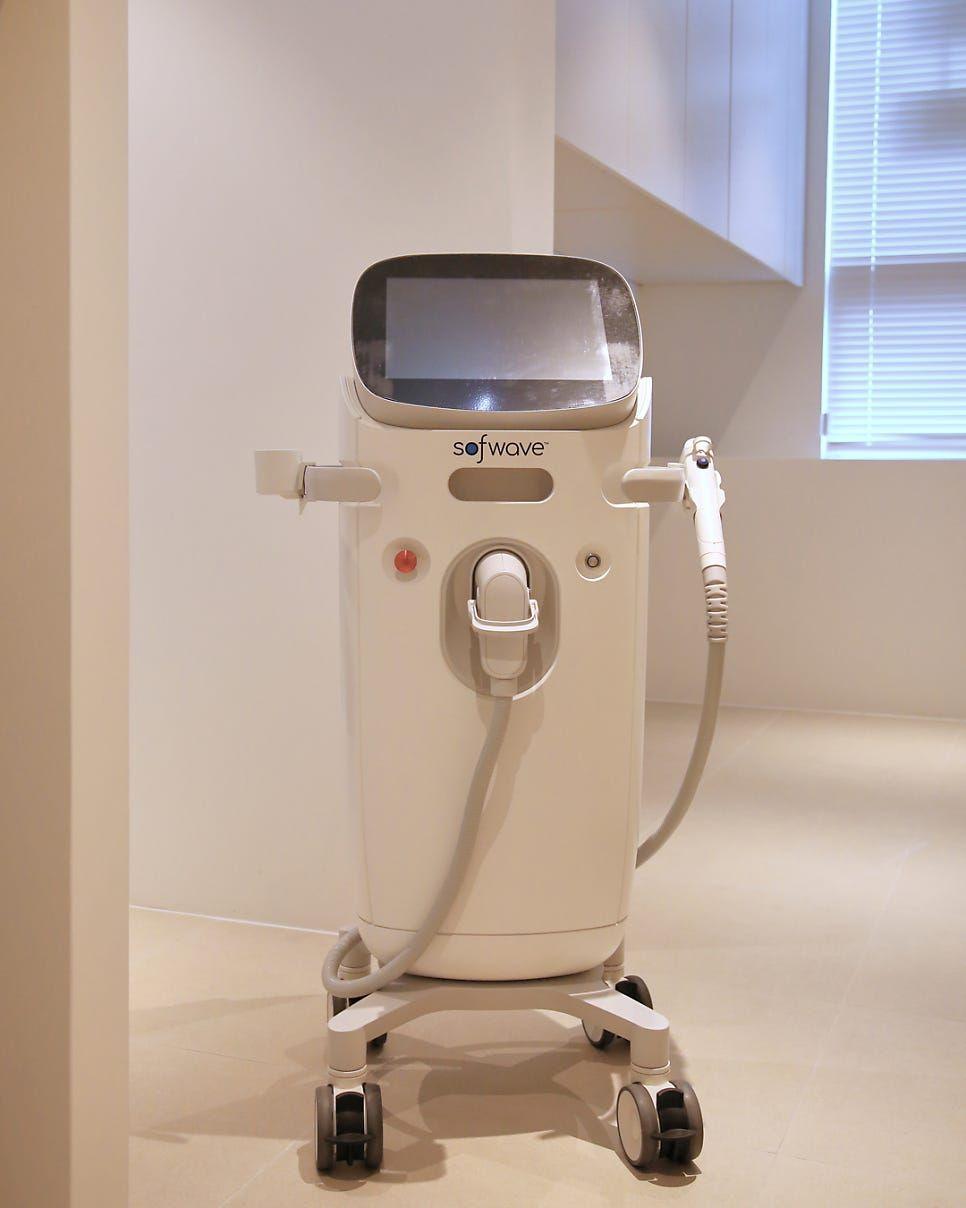
Sofwave for fine lines and pores: who it suits, who it doesn't
Sofwave is not a lighter Ultherapy. It works on a shallower layer, the mid-dermis, and for fine lines around the eyes and mouth it is often the first device I look at.