

Pigmentation
Laser toning for melasma: how many sessions, and when to stop
Toning in many sessions is normal. Toning without anyone judging the response is the problem. Here are the four warning signs, and why one laser cannot treat every pigment.

Written and reviewed by Dr. Hanaram Jang, Medical Director
Published / 5 min read
On this page
Two questions come up in almost every pigment consultation. "How many toning sessions until my melasma is gone?" And: "I paid for a 20-session toning package. Is that right?"
I'll give you my honest answer to the first, and then something more useful: four signs that tell you to stop toning and get reassessed.
First: many sessions is normal
Melasma is not a pigment you beat by hitting hard. High energy creates heat, heat triggers inflammation, and inflammation stimulates the pigment cells again. The result is a rebound: a few days of looking lighter, then darker than before.
So toning works with low energy, breaking up pigment particles gently, below the level that causes inflammation, and repeats that over many sessions. Combined with calming the skin and sun protection, it is a treatment that adjusts melasma gradually toward lighter.
None of that is a problem. The problem starts when "many" turns into "endless."
The honest answer to "how many sessions?"
No doctor can promise an exact number before starting. The depth of melasma, vascular factors, the state of the skin barrier and daily UV exposure all differ, so the same protocol produces different speeds.
So instead of a number, I promise review points: "We'll do this many, look at the response, and decide the next step." After you start, the course goes one of three ways:
| Course | What you see | What should happen |
|---|---|---|
| Responding | Slowly fading | Continue as planned. Near the goal, widen the intervals and move to maintenance |
| Plateau | No change for several sessions | Repeating the same thing is not the answer. Re-diagnose and adjust energy, interval or combined treatment |
| Warning signs | The skin reacts badly | Stop immediately and reassess |
The structural problem with endless toning packages is that sessions continue through the plateau and warning stages simply because sessions remain. It is often not that the clinic is bad. The structure is making the decision instead of a doctor. The trigger should be the response, not the number of sessions left.
Four signs to stop and get reassessed
If you are in the middle of toning, check these.
- White dots appear. Small spots where color has dropped out (punctate hypopigmentation) are the classic sign of excessive repeated toning. These spots can be hard to recover, so this is the most important of the four.
- Melasma has become darker. The energy or interval may not suit your skin, or your barrier may be exhausted.
- No change after five or six sessions. This is a plateau. It is time to change strategy, not to spend more sessions.
- Your face reddens more easily and feels more sensitive. Treatment is moving faster than your skin can keep up.
If any one applies, talk to your treating doctor before the next session. A clinic that checks these signs first and adjusts the plan is a good clinic.
Why ANDO uses several pigment lasers
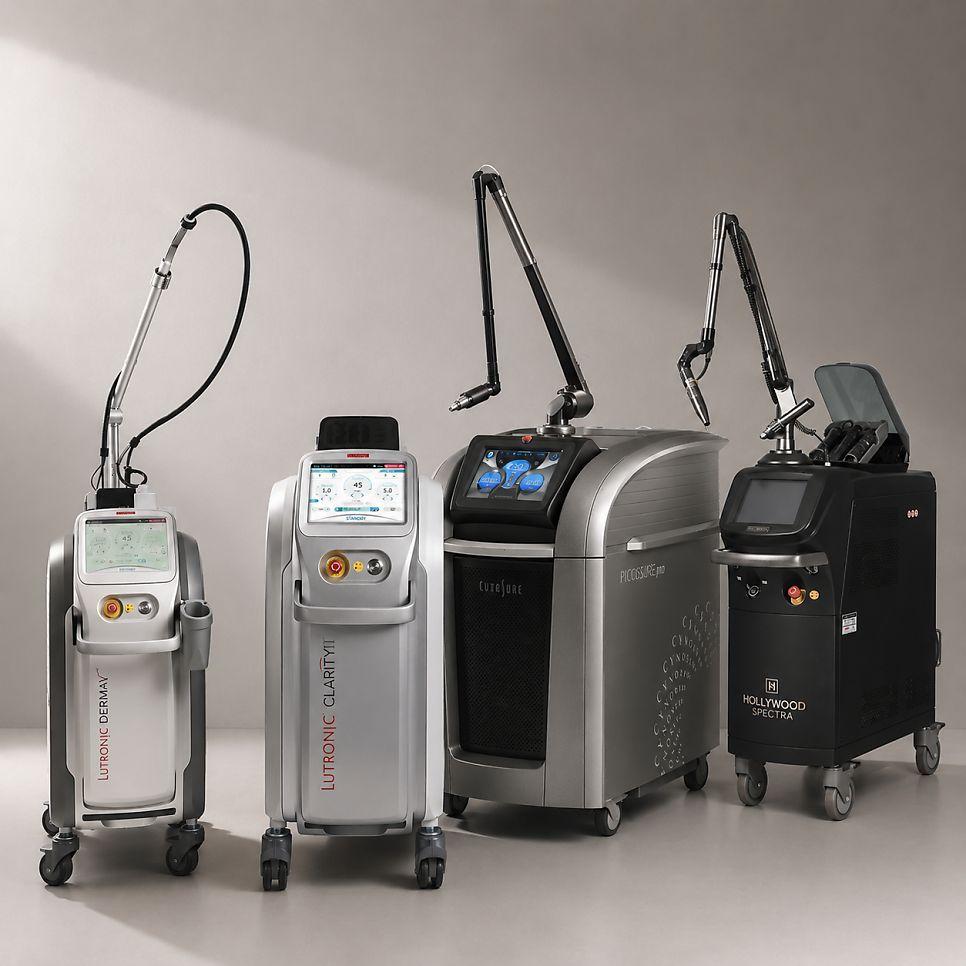
"Doesn't pico toning do everything now?" Picosecond lasers are good. We use them as a main tool. But our laser room has six devices for pigment, and here is why.
Lasers differ by wavelength (which pigment and how deep) and also by pulse duration, how long each shot of light lasts:
- Long pulse (around a thousandth of a second): heats the target and coagulates it slowly. A "warming" laser.
- Nanosecond, Q-switched (a billionth of a second): shatters pigment particles with a shock before heat spreads. Classic toning is this type.
- Picosecond (a trillionth of a second): breaks pigment into smaller pieces with less heat to surrounding tissue.
Pico does not replace long pulse. Pigment that needs breaking suits pico or nano; targets that need gentle heating suit long pulse. They do different jobs. Grouped by job, our six do four things:
| Job | Devices | Used for |
|---|---|---|
| Break | PicoSure Pro (755 nm pico), Hollywood Spectra (Q-switched 1064 nm) | Melasma toning, freckles, sun spots, deep pigment like nevus of Ota and ABNOM |
| Heat | Derma V (long 532/1064), Clarity II (long 755/1064) | Shallow pigment, and the redness and vessels that often come with it |
| Resurface | Erbium YAG (2940 nm) | Raised lesions like moles, flat warts and seborrheic keratosis, which are a thickness problem |
| Prevent recurrence | A+ laser (1450 nm) | Targets oil glands to break the acne and PIH cycle |
For melasma, the rule is "break, but gently": low-energy toning over a long period, while calming the skin and improving the dermis. On our price list, basic dual toning combines Hollywood Spectra and Clarity II, and premium dual toning adds PicoSure.
This is not a claim that more machines make a better clinic. Equipment is only possibility. Six devices without diagnosis mean nothing, and a doctor with two or three who knows their limits can be trusted. The question that matters is whether "why this laser for this pigment?" gets an answer.
If it were my face
I would not judge toning by the number of sessions left in my package. I would judge it by whether someone looks at my skin at each review point and is willing to say "let's stop here and rethink." If you are worried about unused sessions, bring that worry to the consultation. It is a fair topic.
Planning toning around a trip to Seoul
- One trip, one or two sessions. Toning is a series, usually planned at intervals your doctor sets. Use your visit for diagnosis, the first sessions and a clear plan you can continue at home.
- Same-day plans: toning usually allows you to keep sightseeing. Your doctor will confirm for your skin.
- Sun: treated skin reacts to UV. Use enough sunscreen (for the face, about the length of the top segment of your index finger), apply 20–30 minutes before going out, and reapply every 2–3 hours outdoors.
- Bring records: if you have had toning before, note how many sessions, how often and what changed. Photos before and during treatment help most.
Prices for toning, single and 10-session, are on our pigmentation price list. Prices exclude 10% VAT.
Summary
Melasma toning takes many sessions by design, but the session count should never replace judgment. Promise review points, not numbers. Stop and reassess at white dots, darkening, a plateau after five or six sessions, or new sensitivity. And match the laser to the pigment: break, heat, resurface or prevent.
Results differ from person to person. Toning can cause temporary redness, and excessive treatment can cause darkening or light spots.
If you are mid-package and unsure whether to continue, send your treatment record and recent photos on WhatsApp. We can tell you which of the four signs we see and what we would check in person. You can also book a toning consultation.
Questions
I paid for a 20-session toning package. Should I keep going?
Use the four warning signs in this article. If none applies and your melasma is slowly fading, continuing can be reasonable. If you see white dots, darkening, no change after five or six sessions, or new sensitivity, stop and discuss it with the treating doctor before the next session.
Isn't pico toning enough for all pigment now?
Picosecond lasers are good lasers and we use them as a main tool. But pigment that needs to be broken up and targets that need to be gently heated are different jobs. Pico does not replace long-pulse lasers.
Do you sell 10-session toning packages?
Our price list shows single sessions and 10-session prices for basic and premium dual toning. Even with a package, we set review points and adjust or stop based on your skin's response, not on how many sessions remain.
What is the difference between basic and premium dual toning?
On our price list, basic dual toning combines Hollywood Spectra and Clarity II. Premium dual toning adds PicoSure. Which suits you depends on the pigment mix found at diagnosis.
Results vary from person to person. Side effects such as redness, swelling or bruising can occur. The doctor will explain the risks for your treatment at the consultation.
Related articles

Pigmentation darker after laser? Why it happens and what to do
Darker pigment after laser does not always mean failure. It is a temporary reaction, a problem of treatment order, or a problem of diagnosis, and each needs a different response.
Melasma, freckles or sun spots? How to tell pigment types apart
"Dark spots" can mean seven different things, at three different depths. A simple mirror check gives you a rough map, and a better question to ask in any consultation.
Melasma treatment in Korea: why clinics give different answers
Clinics disagree about melasma because what patients call melasma is often several pigments mixed together. Here is why diagnosis comes first, and why melasma is managed rather than cured.